
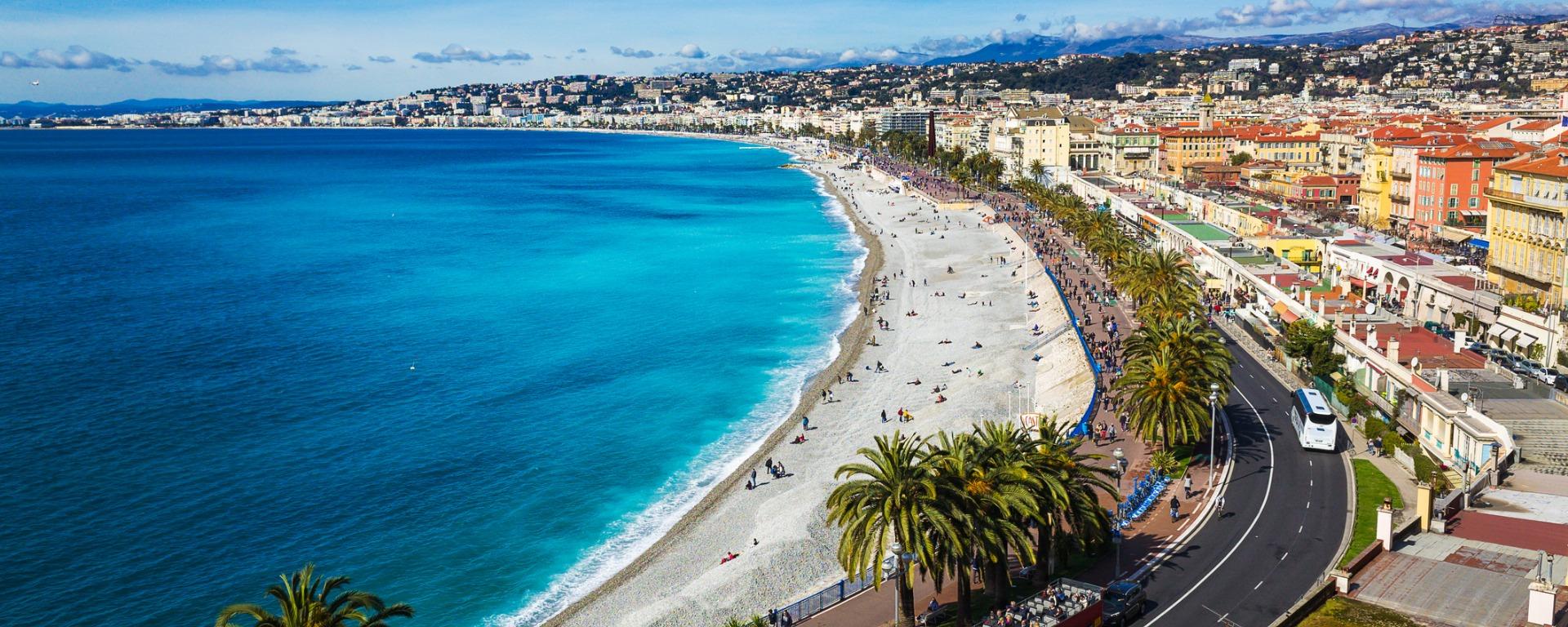
The south of France is often hailed as a dream holiday destination for its stunning location, crystal blue waters, 300 sunny days a year, and fantastic gastronomy. The French Riviera – or Côte d’Azur, as the French call it – stretches from Hyères, a picturesque mediaeval town, all the way to Menton, a coastal town sitting just below the eastern Italian border.
The coastline offers an incredible getaway for all types of travellers, dotted with beach resorts, postcard villages, bustling cities, breathtaking landscapes, historical sites, and much, much more. If you’re looking to spend your summer in this amazing location, here’s our travel guide to the Côte d’Azur.

Menton
The Riviera begins in the charming coastal town of Menton, known for its pastel-coloured buildings, verdant botanical gardens, beautiful beaches, and signature citrus – lemons. The town is often referred to as the capital of lemons, as it produces distinct, highly aromatic lemons with protected geographical indication (PGI) and hosts the Fête du Citron (Lemon Festival), which attracts around 200,000 visitors every year. If you’re passing through, make sure to try a local lemon tart and limoncello.

Monaco
For nightlife and glamour, head to Monaco – a sovereign city-state on the Riviera and the world’s second-smallest country. This coastal tax haven is world-renowned for the Monte Carlo Casino, its dense concentration of superyachts, opulent lifestyle, and hosting the Formula 1 Grand Prix.
Since hotel prices can be quite extortionate, you can easily take a day trip to Monaco from Nice or other surrounding towns. Drive into the city centre – no passport checks required – and park next to the casino, which will cost you a few euros per hour. Then you can stroll through Monaco City and marvel at the incredible architecture; visit the Oceanographic Museum, the Prince’s Palace of Monaco, and Port Hercules, a bustling marina filled with impressive yachts.

Èze
Less than a twenty-minute drive away from Monaco is the breathtaking hilltop village of Èze, known for its winding cobblestone streets, mediaeval charm, and romantic atmosphere – an ideal location for a serene honeymoon on the azure coast. Sitting at an altitude of 430 metres above the Mediterranean, it boasts unbeatable panoramic views of the sea and surrounding towns.

Villefranche-sur-Mer
Perched on a harbour is Villefranche-sur-Mer, a picturesque fishing town and one of the prettiest towns in the South of France. It is renowned for its deep natural harbour, vibrant pastel houses, and 16th-century Citadel. Visit the charming Old Town and stroll through Rue Obscure, a unique 13th-century covered passage and one of France’s oldest streets.

Saint-Jean-Cap-Ferrat
To the east of Villefranche-sur-Mer is the exclusive peninsula of Cap Ferrat, which boasts luxury holiday homes, a postcard-beautiful lighthouse and the authentic small community of Saint-Jean-Cap-Ferrat, which has managed to retain much of its old-world charm. The peninsula’s major attraction is Baroness Beatrice Ephrussi de Rothschild’s sumptuous villa, which, in addition to the building itself, includes seven magnificent gardens and a first-class collection of art and porcelain.

Nice
The heart of the Riviera is without a doubt Nice. The city ranks second among French cities for the most museums, so there is much to discover for those interested in culture and history (do not miss the fantastic Matisse Museum). If you want to experience the French ambience instead, you can stroll along the iconic Promenade des Anglais, look at port life, and soak up the scents of the sea and market stalls before heading to the old town (Vieille Ville) and its many colourful buildings, lovely markets, and beautiful churches.
In Vieille Ville, you will also find many of Nice’s most popular nightclubs and restaurants. The people of Nice are proud of their food, and there are many classics from the area that are not to be missed on the menu, such as Salade Niçoise, La Socca, and plenty of fresh seafood.

Les Corniches
The Corniches are three spectacular scenic coastal roads that link Nice and Menton, winding dramatically along cliff faces high above the Mediterranean Sea. They are named according to their altitude: the Basse Corniche (or Corniche Inférieure), which runs along the coast; the Moyenne Corniche, which sits higher up and connects Nice to Monaco via Èze; and the Grande Corniche, the highest and oldest of the three, offering the most breathtaking panoramic views and following the route of the ancient Roman Via Julia Augusta.

Cannes
Cannes is not only known for the film festival, which every year attracts the world’s greatest actors and directors to the city, but also for its old town, Le Suquet, and glamorous nightlife. At the Palais de Festival is the Allée des Stars, where you can follow in the footsteps of movie stars and compare handprints with those of celebrities such as Cameron Diaz, Gérard Depardieu, and Meryl Streep. If you do not win a golden palm, you can instead stroll along the palm trees on the Promenade de la Croisette or enjoy a culinary taste experience at the two-star restaurant Palme d’Or, which, during the festival, is usually crowded with famous faces.

Nice vs Cannes: Where to Stay?
If your dream Riviera getaway involves a deep dive into culture, history, and vibrant city life, Nice is the clear winner. It offers a larger urban area, more museums, and excellent transport links for exploring the wider region.
However, if your priorities lean toward high-end glamour, proximity to exclusive beaches, and the energy of a world-famous film festival hub, Cannes provides that concentrated luxury atmosphere. Nice feels like a bustling, authentic city, while Cannes offers a more polished, resort-like feel.

Antibes
Antibes is immensely popular for several reasons: sandy beaches, one of Europe’s largest marinas, a genuine city centre and a rich range of restaurants, to name a few. Those who feel like shopping can head to the Marché Provençale market – or browse for lavender soaps, exclusive vintage clothes and other delights in the city’s small shops. At dusk, you can take the 20-minute walk to the neighbouring town of Juan-les-Pins to explore its bustling nightlife. Juan-les-Pins is also known for its annual jazz festival, which, for ten days in July, attracts both world stars and promising new artists.
Grasse
Nestled in the hills north of Cannes is Grasse, renowned as the historical world capital of perfume and home to a UNESCO-listed fragrance industry. This scenic location is a breath of fresh air in comparison to the Riviera’s bustling coastal resorts, thanks to its verdant setting of mountains, forests, and flower fields. Wander under the iconic bright pink umbrellas in the Old Town and take a tour of one of the area’s many perfume museums, where you’ll be able to create your own unique fragrance.
Sainte-Maxime, Saint-Tropez, and Huyères
After Cannes, follow the famous stretch of road down to Sainte-Maxime, which is considered by many to be one of the most beautiful in Europe. Don’t forget to keep your eyes on the road as it meanders like a garland with sharp curves and dramatic hills. Sainte-Maxime, like its neighbouring towns, Port Grimaud and Saint Tropez, is the playground of the rich, with lots of champagne, luxury yachts, and sports cars along the streets. If you don’t want to burn your entire annual salary in one go, the neighbouring town of Hyères is recommended, where prices are lower, the pace is slower, and many beaches are free. Continuing west, you will reach France’s second capital city, Marseille, and other parts of Provence.
Sandy Beaches vs Pebble Beaches
The French Riviera offers a diverse beach experience, broadly categorised by geography: the eastern coast, spanning from Menton to Antibes, predominantly has pebble beaches, like those in Nice, while the western stretch, from Antibes/Cannes down toward Saint-Tropez, boasts more sandy shores. Pebble beaches are prized for their crystal-clear waters and cleanliness, making them ideal for a relaxed, sand-free picnic, whereas sandy beaches are generally preferred by families for their shallower areas and comfortable lounging.
When’s the Best Time to Visit the French Riviera?
The Côte d’Azur is an incredible holiday destination year-round, offering approximately 300 sunny days every year. The best time to visit the Riviera depends entirely on the type of experience you’re after: travelling during the summer months means enjoying the area’s local festivals and major events, peak beach activities, and a lively night scene, but also larger crowds and higher prices. Those wanting to get away from the cold and enjoy some winter sun can travel between November and March for milder weather and better prices.
Explore France’s Stunning Côte d’Azur with Secret Escapes
The French Riviera is a destination that truly lives up to its glamorous reputation. From the citrus-scented streets of Menton to the luxury yachts of Monaco and Saint-Tropez and the cultural heart of Nice, the Côte d’Azur offers a captivating blend of stunning natural beauty, historical charm, and vibrant city life.
Plan an unforgettable retreat to the azure coast without breaking the bank with Secret Escapes’ unbeatable deals on France holidays. From discounts on beach hotels to package holidays, our offers ensure you can enjoy a luxury retreat without the luxury price tag.
For more travel advice and inspiration, deep dive further into the Escapist magazine or get in touch for more information.


